Your Company Needs a Company Knowledge Base
A practical answer to business ontology: how a company brain turns second brain thinking into shared context for people and AI agents.
In this article
The CRM knows the customer. The inbox knows what was promised. The project tracker knows the work in motion. The support queue knows what broke. The finance system knows the metric. The shared drive knows the deck. The meeting transcript knows what changed. The person who remembers why the process exists is on vacation.
The information exists. The operating context is scattered.
That is the real business ontology problem for most companies.
Ontology sounds like graph databases, semantic models, and months of architecture work. The first useful answer is simpler: a maintained company knowledge base that explains how the business works and gives agents a place to look before they act.
Start with shared operating language: what things are called, where the truth lives, who owns the workflow, what can be updated, and when judgment is required.
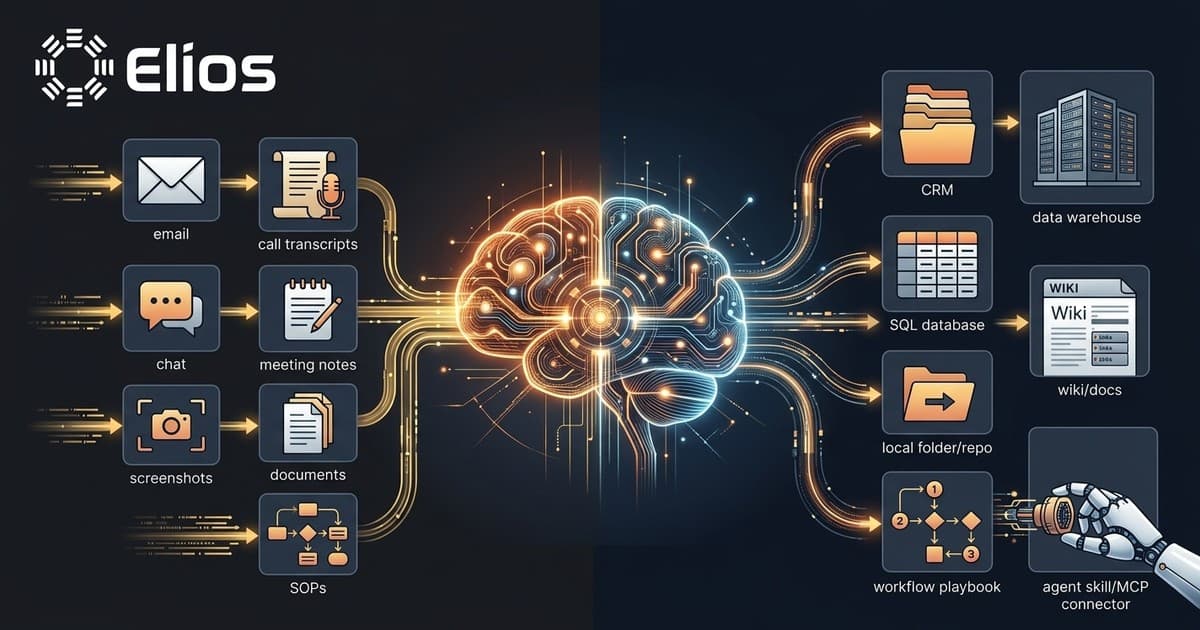
A company knowledge base is the practical answer. It becomes the high-level layer that explains how the company runs across CRM, finance, data, support, operations, documents, meetings, and internal tools. People can read it directly. Agents can search it, follow it, and propose updates with review.
That knowledge base can live in Notion, Confluence, Obsidian, a Git repo, shared folders, or a custom system. The tool matters less than the operating layer it creates.
Treat it as a map instead of a dumping ground. It should explain where the real systems of record live, how to access them, which workflow to follow, and why the company made those choices.
The payoff is practical: fewer stale records, cleaner handoffs, faster onboarding, better training, and agents that stop guessing how the business works.
Here is what that looks like in real work. A customer call changes the scope of an active engagement. The promise is in the transcript. The commercial next step is in email. The project owner needs a handoff note. Finance needs the right status for forecast and margin. Support or field operations needs to know whether there is risk. A field team may need the updated change order, job-costing status, or safety note. Leadership needs the change to show up in the next operating review.
Without a company knowledge base, every system gets a partial truth. The weekly operating review is wrong. Margin risk stays hidden. Delivery repeats discovery. The field team works from an old instruction. With a knowledge base, the workflow can say: read the transcript and related email, identify the customer and project, update the CRM note in the approved format, draft the project handoff, flag finance when the status changes, ask for approval before writing anything uncertain, and log what changed.
That example could be a SaaS renewal, a construction change order, a consulting engagement, or a post-acquisition cleanup. The shape is the same: the work happened, and the company needs to learn from it.
What is a company knowledge base?
Every company already has knowledge scattered across tools. The company knowledge base does not replace those tools. It explains the work around them.
A company knowledge base sits above the transactional systems as a high-level operating layer. It does not duplicate HubSpot, Salesforce, Snowflake, your SQL database, your support platform, or your finance platform. Those systems exist for good reasons. They are where the transactional truth belongs.
The company knowledge base explains the work around them:
- Who owns the workflow. The accountable person, team, or decision-maker.
- What the source of truth is. The system, table, folder, workspace, or record that should be trusted.
- How to access it. The connector, API, MCP tool, saved query, permission boundary, or manual process.
- Why it matters. The business purpose, escalation rule, and decision context.
- What good looks like. Examples, checklists, templates, and accepted output.
That layer gives the company context it is missing. It is the difference between "summarize this call" and "summarize this call, update the right CRM record, connect it to the right open workflow, use our account-note format, and ask before writing if confidence is low."
How a company knowledge base keeps records current
The same concept applies to the data that enters the company.
Calls, emails, chats, and documents already contain the state of the business. People are expected to move that state into the systems that need it, which is why CRM notes go stale, account history disappears into inboxes, and customer calls turn into memory instead of operating data. The work happened, but the system did not learn.
The same pattern applies to email, Teams, Slack, call transcripts, support tickets, project updates, finance notes, field notes, and shared docs. The point is to identify the business state that should survive the conversation, then route it to the right system.
The real constraint is ownership, permissions, review, and deciding what is safe to write back. A company knowledge base gives agents the rules before they touch the systems.
At Elios, this is the shape behind Argus, our managed agents accelerator, which turns approved inbox and meeting evidence into system updates. Approved Outlook inbox and outbox context, plus meeting transcripts, become source evidence. Agents use that evidence to propose HubSpot and Elios Insights updates with the right approval path.
The important part is the pattern: decide what business state should survive a conversation, route it to the right system, and keep a human owner accountable for the knowledge layer.
How the company knowledge base stays alive
The failure mode is obvious. Someone launches a beautiful Notion, Confluence, SharePoint, Obsidian vault, or folder structure. Six months later, everyone knows the real answer lives somewhere else.
The operating model matters as much as the content.
Every durable workflow page should define:
- Owner. The person or team accountable for the workflow.
- Reviewer. The person who decides whether changes are accurate.
- Source system. The system that holds transactional truth.
- Allowed writes. What an agent can update, draft, or propose.
- Approval path. When a person must approve before anything changes.
- Audit log. Where changes, sources, and decisions are recorded.
- Expiration rule. When the page needs review or retirement.
- Access boundary. Who can read the source material and who cannot.
- Success metric. What should improve if the workflow is working.
That sounds heavier than "write a wiki page," because it is. A wiki that no one trusts is just another place to search. A working operating layer gives people rules they can inspect and gives agents rules they can follow without inventing policy.
A company knowledge base has to work for humans
This layer belongs in front of humans too. The knowledge base should be useful to people reading it directly.
A new operator should be able to understand how the business works before asking ten people for the same history. A finance lead should be able to find the source system for a metric. A sales leader should be able to see how account notes are supposed to be written. An executive should be able to trace why a workflow exists and who owns it.
That human readability is a quality check. If the knowledge base is too vague for a person to use, an agent will eventually misuse it too.
Every company should also have a human owner for this layer. Call that person a Knowledge Czar if the phrase helps people remember the job. The title is informal, but the responsibility is serious: audit the knowledge base, check for inaccurate pages, remove stale instructions, resolve contradictions, and make sure company history has not been flattened into whatever the last transcript happened to say.
Agents can help find broken links, missing owners, stale pages, orphan concepts, and claims without citations. They can draft fixes. They still do not carry the full company context in their head the way a veteran operator does. Human judgment belongs in the loop.
Business ontology can start with plain language
Ontology sounds heavier than it needs to be.
For most companies, a useful ontology starts with plain language:
- Customer
- Account
- Opportunity
- Project
- Ticket
- Meeting
- Owner
- Approval
- Metric
- Policy
- Source of truth
- Escalation path
- Workflow
Then define how those concepts connect. A customer has accounts. An account has opportunities. A ticket can update a customer risk. A meeting can create an approval. A metric has a source system. A policy has an owner. A workflow has an escalation path.
You do not need the perfect semantic model on day one. You need the smallest shared vocabulary that helps agents route work correctly.
If a person on the team says "this belongs on the account," another person and the agent should both know what "account" means, where the account lives, which fields matter, who owns it, and what is safe to update.
That is ontology doing useful work.
A company dictionary turns shorthand into operating context
The first useful artifact is usually a company dictionary.
Every company has acronyms, overloaded words, and internal names that carry real operating meaning. A "pilot" sounds obvious until sales, product, finance, and legal each mean something slightly different. If those meanings live only in someone's head or inside one platform, agents will guess and new employees will ask the same question forever.
A company dictionary entry should make the term usable by a new employee and safe for an agent.
Term: Pilot
Plain meaning: A time-boxed customer trial with a named owner, success criteria, and an agreed next step.
Source systems: CRM for commercial status, project tracker for active work, shared docs for notes.
Owner: Account owner.
Connected concepts: customer, opportunity, scope, success metric, legal approval, renewal path.
Use when: Linking calls, emails, risks, decisions, and follow-ups to an active trial.
Do not confuse with: free trial, proof of concept, production rollout, renewal, or signed contract.
Review owner: Revenue operations.
The formatting is boring on purpose. The value is that the company stops relying on folklore.
Andrej Karpathy's LLM-Wiki is a useful inspiration, in plain English: a personal second brain turns notes and sources into reusable knowledge. The company version is the same idea applied to shared operating context: source-of-truth maps, owners, workflows, playbooks, access paths, and the judgment calls people and agents need before they act.
Agent skills turn company knowledge into behavior
A company knowledge base answers, "What does this company know?"
Agent skills answer, "How should the agent behave when this work appears?"
Those are different layers, and both matter. The boundary can overlap.
A workflow is the company's preferred way to do a job. A skill is the instruction set that helps an agent perform that workflow consistently. When a workflow repeats often, has clear inputs, needs source checks, and requires validation, it usually deserves to become a skill.
A good AI agent skill gives the agent a trigger, a workflow, references to inspect, and a validation loop. Skills can live in code repos, local folders, or shared enterprise environments.
For a company knowledge base, the shared skill can say:
- Search the company knowledge base before asking the user for facts.
- Prefer source systems over copied data.
- Use the company glossary when naming entities and workflows.
- Follow the playbook attached to the workflow.
- Ask for human approval before writing to a system of record.
- At the end of a successful workflow, ask whether the new pattern should be documented.
The knowledge base gives context. The skill gives repeatable behavior. The MCP connector gives approved access.
Together, those three pieces make agent work repeatable instead of improvised.
Connect the company knowledge base to the agents people already use
Most companies should start by making the knowledge base useful to humans and reachable from the agent tools people already use.
Give the company knowledge base an MCP connector or another approved interface. Then add a shared skill for the agent tools your team already uses. Add team-level instructions that tell agents the company brain exists, what skill to load, and which connector to call.
Now the finance lead, operator, sales leader, product manager, and engineer can all use the same company context from their own work surface, whether they are reading it themselves or asking an agent to act with it.
This is one practical path to becoming AI-native: your systems become reachable, your workflows become reusable, and your people stop re-teaching the same context in every session.
Let people and agents contribute back
The company knowledge base fails when it becomes a static intranet that dies after launch. It should behave more like an internal Wikipedia for how work gets done, with humans improving it and agents drafting updates.
Every successful workflow is a chance to improve it.
Custom instructions can make that loop easier inside the assistant tools people already use. Team-level instructions for Claude, Cowork, Codex, or another work assistant can remind the agent that the company knowledge base exists, that a shared skill is available, and that meaningful new patterns may deserve an update.
That reminder should not fire after every small task. It gets noisy fast. It should trigger when the agent finds a source of truth, resolves repeated confusion, follows a new workflow, handles a changed process, or completes work the next person should not have to rediscover.
After an agent helps with a new workflow, it can ask:
Do you want to document this in the company knowledge base?
If the answer is yes, the agent can draft the page, cite the source materials, link the related systems, assign an owner, and mark it for review. A person still approves the durable knowledge. The agent does the collection and structure work.
The human owner keeps the standard high. They decide whether the new page reflects how the company actually works, rather than treating the latest meeting as the whole truth.
That contribution loop matters more than the initial tool choice. A Notion workspace that updates every week is better than a perfect graph that no one maintains.
Make the company knowledge base useful by function
The "second brain" idea gets more valuable when it moves from personal productivity into company operations. That does not mean every department needs its own separate wiki. It means the company knowledge base should contain the operating context each function needs to do real work.
Sales and revenue need account history, call notes, open follow-ups, pricing context, handoff rules, renewal risks, and CRM hygiene. Done well, fewer accounts have the real story living in someone's inbox.
Customer success and support need ticket history, escalation paths, support commitments, renewal context, product gaps, and examples of good customer updates. Triage gets faster because the next person can see the history.
Professional services and client delivery need discovery notes, proposal logic, SOW assumptions, client preferences, delivery handoffs, QA checklists, and reusable expertise from prior engagements. That reduces repeated discovery, margin leakage, and quality drift across teams.
Operations and field delivery need SOPs, project status, service notes, worksite updates, vendor context, change-order rules, process exceptions, and the current way work actually gets done. People get a better answer when they ask, "How do we handle this now?"
Finance needs metric definitions, approval paths, reporting sources, forecast assumptions, and the difference between board-reporting language and operating language. Fewer meetings turn into arguments about whose number is right.
Compliance and training need policies, certifications, incidents, corrective actions, approval owners, and the training material that changed after the last lesson learned. Training stays closer to how the work actually happens.
Leadership needs decision history, owner directories, operating cadence, escalation rules, acquisition context, and the history behind strategic choices. The company remembers why it works the way it works.
The pattern is the same across functions: raw business material becomes curated company knowledge, and curated knowledge becomes better work.
What to include in a company knowledge base on day one
Do not overbuild the first version. Start with the knowledge an agent needs to avoid asking obvious questions.
Create these pages first:
- Company glossary. The words your company uses and what they mean.
- Systems map. The tools you use, what each one owns, and who has access.
- Workflow map. The core operating workflows and the source systems they touch.
- Playbooks. Step-by-step instructions for recurring work.
- Owner directory. Who owns each workflow, system, approval, and escalation path.
- Contribution rules. How agents and people add knowledge back.
- Human owner. The person accountable for knowledge quality, freshness, and disputes.
- Review cadence. When pages expire, who reviews them, and how stale instructions get removed.
That is enough for useful agent behavior. The rest can compound from real work.
Build the company brain before the graph database
There are situations where a graph database makes sense. If you have the data maturity, the use case, and the engineering ownership, use one.
Graph theory is rarely the blocker. The blocker is that no one has written down how the business actually runs in a format people can search and agents can follow.
Start there.
Pick the place your team will maintain. Define the operating rules. Connect it to the agent tools people already use. Write the shared skill. Teach agents where the source systems live. Let people contribute back after successful work.
Your company knowledge base does not need to be complicated. It needs to be searchable, updateable, governed, and useful to humans first.
That is enough to make the business more legible. Once agents understand the who, the what, the how, and the why, they stop being generic assistants and start becoming part of how the company runs.
FAQ about company knowledge bases
What is a company knowledge base?
A company knowledge base is the maintained operating layer that explains how the business works. It names the workflows, owners, systems of record, approval paths, definitions, and playbooks required to act correctly.
Does a company knowledge base replace Snowflake, Salesforce, HubSpot, or a SQL database?
No. A company knowledge base sits above those systems of record and explains how to use them. Snowflake, SQL databases, HubSpot, Salesforce, finance platforms, support tools, and project systems should continue to hold transactional truth. The company knowledge base tells people and agents where that truth lives, who owns it, how to access it, what can be updated, and when approval is required.
What is a company brain?
A company brain is the agent-readable version of the company knowledge base. The phrase is useful because it captures the goal: a shared memory for how the company runs, while keeping the real systems of record where they already belong.
Is a company knowledge base a second brain for business?
A personal second brain organizes one person's notes, sources, and outputs. A second brain for business needs governance: owners, permissions, review paths, source-of-truth boundaries, contribution rules, and shared language across teams.
Do you need a graph database for business ontology?
Usually, no. Start with a shared vocabulary, a company dictionary, source-of-truth rules, and workflow pages people will maintain. A graph database can help later when the use case, data maturity, and engineering ownership justify it.
If one workflow came to mind while reading this, that is the right starting point. Do not start with a company-wide wiki rollout. Start with the workflow your team keeps re-explaining, the records that keep going stale, or the handoff that keeps dropping context.
Talk to Elios when that problem is real enough to solve. We will map the systems, define the knowledge layer, write the agent skill, and put human review around the work.
Give us one problem. Let us prove it.