Most companies trying to become AI-native do the same two things. They buy ChatGPT seats, and they send a memo. Then they wonder why nothing changed. Here is the honest answer to the question we hear most: making your company AI-native is not a purchase. It is a change in how every person and every team works, and that takes people, process, and a real engineering floor underneath.
We started Elios because we kept watching AI projects fail on the org, not the model. (We unpack why 80% of them fail in our launch post.) This guide is the practical version: what AI-native actually means, and the sequence to get your company, your team, and yourself there. If you want the operating model underneath that sequence, the AI-native Journey shows how to split each workflow between software, AI, and a named person, and who owns the result.
What does it mean to be AI-native?
Being AI-native is having AI in the loop on the real work: research, analysis, presentations, financial models, operations, hiring, the decisions that move the business, not just engineers writing code. In an AI-native company, before anyone hires for a role, the first question is whether AI can do the work. Before any team designs a workflow, it asks how AI makes the work faster. Sometimes the answer is still a person, ideally an AI-native one. The point is that the question gets asked, every time.
How do I make my company AI-native?
Start at the top with the AI-first question, put AI in the loop on the real jobs across every function, make your data reachable by agents, equip every person to use it, and deploy the people who can do the work. Here is the sequence.
1. Ask the AI-first question, every time
Before you open a req or design a workflow, ask whether AI can do the work first. This is a leadership decision, not an IT one. When it becomes the default question across the company, everything downstream changes.
2. Put AI in the loop on the real jobs, not just engineering
AI-native is not an engineering program. It shows up in finance, operations, revenue, people, and legal long before it touches your codebase. The next section has the concrete examples by function.
3. Make your data reachable by AI
This is the technical floor, and it is where most transformations stall. To be AI-native, your data and systems have to be reachable by agents in a format built for them: MCP Connectors (or CLIs) and skills an agent can actually call. Data locked inside systems no agent can reach is not AI-native, no matter how many seats you bought.
4. Equip every person, not just engineers
Give your people an agent harness they can actually use. Claude and Codex now ship desktop apps for Mac and Windows, no terminal required, so a finance lead or an operations manager works the same way an engineer does. Then share skills across the company, so the best workflow one person builds becomes everyone's.
5. Deploy the people who can do the work
Strategy without people is a memo. You need AI-native specialists who embed in the real workflow, learn how your team works, and change it from the inside. That is the part we deploy, and it is where most transformations either land or stall.
How do I make my team AI-native?
This is where it gets concrete. Making a team AI-native means the daily work runs with AI in the loop. A few examples that translate to almost every business:
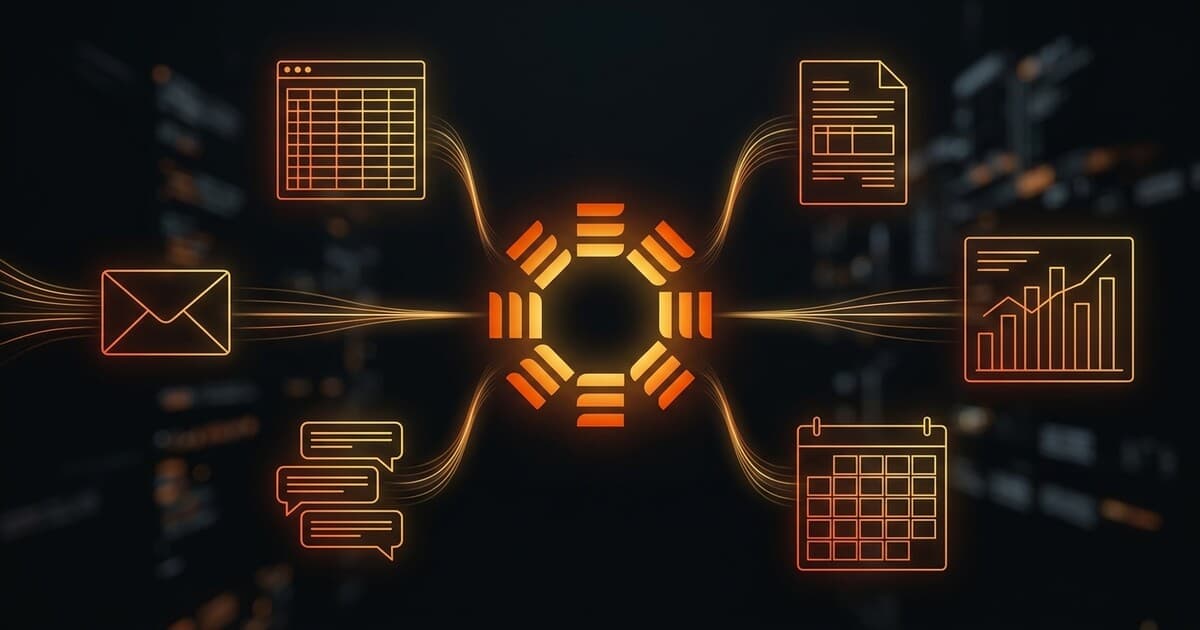
- Revenue and communications. Your inbox reads itself, surfaces the messages that matter, drafts replies in your voice, and updates your CRM from what lands there. Every meeting turns into follow-ups, notes, and CRM updates without anyone typing them up.
- Finance. Budget against actuals becomes a variance workbook. A cash-flow model flags the weeks you run low. A pile of receipts, invoices, and screenshots becomes a clean, structured spreadsheet.
- Operations and leadership. A weekly metrics report builds itself from your dashboards every Friday, in your template. A quarterly or board update assembles itself from scattered notes and project docs. A morning briefing pulls from across your tools so nothing important stays buried.
- Sales and go-to-market. Feedback from calls, chat, and CRM notes gets synthesized into the patterns that matter and a ranked list of what to fix or build next.
- Research and strategy. A market sizing comes back with the analysis, the spreadsheet, and the deck to present it.
- People and legal. New-hire onboarding gets coordinated from offer to first week. A folder of contracts or case files becomes a chronological, labeled set, with the items that matter called out.
None of this is engineering work, and that is the point. Work that used to demand a team of engineers and weeks of build, an AI-native person now stands up in an afternoon. The operational bottleneck analysis that used to wait on an outside consultant, a team lead now runs themselves and keeps pulling the thread.
Your systems have to talk to each other
For any of this to work, the AI has to reach your systems. Some software you already own ships these connectors. Where it does not, your IT team approves the ones that do, and our deployed specialists or an embedded pod build the layer that links your legacy data and services into play. The access is governed: the right people and the right agents touch the right data, and nothing else.
How we did it at Elios
We built our platform, Elios Insights, to be AI-native from scratch, with a custom MCP connector so agents can reach it directly. We run HubSpot as our CRM and Otter for meetings. We ingest Otter transcripts into HubSpot automatically, so the record writes itself. Our workforce team's Outlook inboxes keep Elios Insights current on where every candidate sits and how close we are to filling each role. Everyone at Elios can make AI part of their workflow, in a language agent harnesses like Claude and Codex understand.
The shift is already underway at the companies furthest along. As Joel Hron, CTO of Thomson Reuters, put it:
The human role becomes validation, refinement, and decision-making. Not repetitive rework.
That is the whole idea. AI does the heavy lifting. Your people make the calls. The technology amplifies judgment, it never replaces it.
How do I become AI-native, as a person?
Pick one agent harness, use it on your real work every day, and make "can AI do this first?" your default question. Start with the task you dread most: the weekly report, the inbox backlog, the spreadsheet cleanup. Hand it to an agent, refine what comes back, and keep the version that works as a skill you reuse. Do that for a month and you will not go back. An AI-native person is not someone who read about AI. It is someone whose day already runs on it.
What's blocking you? We can help.
Is your company AI-native? If not, the blocker is usually one of three things: the AI-first question is not being asked, your data is not reachable by agents, or your people do not have the skills and the people to change the work. We deploy against all three. Two ways to work with us, one operating system behind both.
Deployed Specialists. When you need AI-native people fast, we deploy them. We start with your actual role, source through Elios Insights, and put a vetted specialist in front of you in as little as 48 hours, from a Head of AI to forward deployed engineers to QA. Every placement clears a hard AI-native screen. Convertible to full-time.
Embedded Teams. When you need the problem solved, we embed a pod. Senior delivery operators run Elios OS, bring the platform and the accelerators, solve alongside your team, and transfer the capability when they leave. You own it after, not a dependency.
Both run on Elios OS, our method of Diagnose, Embed and Solve, Transfer, so a small pod does what takes other firms dozens of people, and the capability stays with your team.
Tell us where AI should be doing the work and is not. We will learn your business and find the right way in. Give us one problem. Let us prove it.